
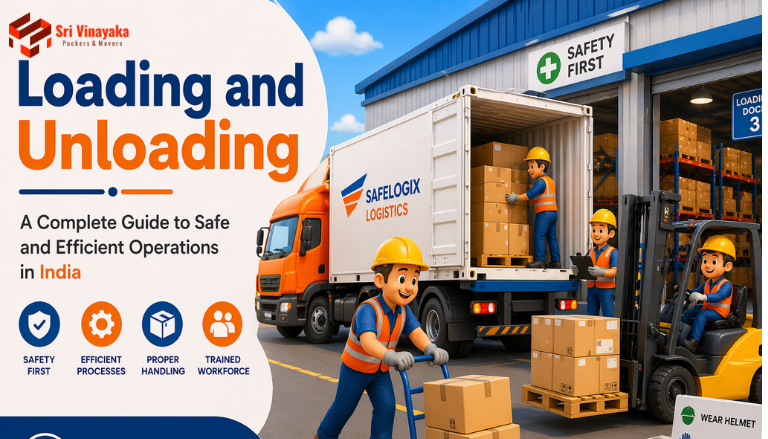
Loading and Unloading: A Complete Guide to Safe and Efficient Operations in India
Every day across India trucks, ships, and warehouses are being loaded and unloaded with millions of tonnes of goods. From shifting families’ household items to transporting raw materials for industries, loading and unloading are fundamental to the Indian logistics economy.
However, mishandling may cause the damage of goods, injuries, and unnecessary expenses. This load and unload guide – in conjunction with the Indian audience – will help you understand the right way to load and unload by giving you time, money, and stress-saving tips.
What Is Loading and Unloading? Core Concepts Explained
Loading and unloading are two separate functions that constitute the total operation of transferring goods from a vehicle, container, or any other mode of transport to a location and vice versa. A simple definition of loading is putting the items into a truck, a ship, or a train and unloading is conversely taking them out. The process is indispensable in logistics warehousing construction, as well as the moving of personal belongings. Research shows that 25% of the damage of cargo occurs as a result of improper loading and unloading.
What Is Meant by Loading and Unloading?
Besides lifting boxes, loading and unloading also include packing, stacking, securing, and arranging items to avoid movement during transport. For instance, if a moving truck is loaded with household items, weights should be evenly distributed, fragile items should have padding, and everything must be securely strapped. Unloading entails turning the steps around. However, you need to be very careful since it involves inspecting for damages, checking the manifest, and moving safely to the designated places.
Key Aspects of Safe Loading and Unloading
Handling goods should never be a cause of accidents which is why AIOverview by Google points out five main pillars: planning, safe handling, traffic management, safety equipment, and proper unloading procedures. In India where roads may be in poor condition and loading bays very small, such points are even more important.
Planning and Preparation: Check a vehicle first, such as tires, brakes, and load capability before beginning. Also, level the ground and clear the area of overhead wires. In case of a scenario like a truck parked on a slope, it may cause the vehicle to roll during unloading resulting in major accidents.
Safe Handling and Loading: Employ purchasers who are well-trained and are aware of the correct stacking procedure so that the lower boxes are not crushed. Heavy objects must be placed at the bottom and light on the top. Insert separators such as cardboard or foam between delicate goods to prevent dents.
Traffic Management: If possible, define safe zones with cones and barriers so that pedestrians are prevented from coming near moving vehicles. Especially in crowded Indian market areas or even residential ones, children and animals may wander close to the loading bay.
Safety Equipment: The staff should have on them safety vests with high visibility; safety shoes, preferably steel-toe; and hard hats. In case of a night shift, reflective tape and proper lighting are obligatory. In fact, many Indian logistics companies have these vendors as standard right now.
Unloading Procedure: Once the goods have arrived, a standard operating procedure (SOP) must be followed. First, check that the shipment matches the manifest. Then inspect for transit damage. And finally, move items systematically so as not to block the exits.
Each of these steps support the greater aim of damage-free, injury-free loading and unloading. When you engage loading and unloading services of professionals like Sri Vinayaka Packers & Movers, these are the things that they follow as their standard package.
Loading and Unloading Hazards and Control Measures
Recognising hazards is the first step to preventing accidents. Most common risks during loading and unloading as presented by HSE (Health & Safety Executive) study guide and also regulatory bodies include – slips, trips, falls from vehicle heights, being hit by moving equipment, and muscle strains from manual lifting. Below is a practicable control measure for each:
Slips and trips on wet or cluttered loading docks
Use anti-slip floor paints and ensure no loose straps or boxes lie in walkways.
Falls from truck tailgates or container edges
You should always maintain three points of contact (two hands and one foot, or two feet and one hand) when climbing. Also, use step ladders or dock levellers rather than jumping.
Being struck by forklifts or reversing trucks
Make the use of audible reverse alarms and appoint a spotter to guide drivers. Separate pedestrian walkways using yellow paint or physical barriers.
Muscle strains from lifting heavy loads
Using mechanical aids like pallet jacks, trolleys, or conveyor belts. When manual lifting is unavoidable, train workers to bend their knees and keep the load close to their body.
In addition to warehouses, such risks could also be experienced while shifting homes. Packers and movers companies, such as Sri Vinayaka Packers & Movers, train their teams in these control measures and also take insurance for any unexpected damages.
Conclusion
Loading and unloading may seem like simple tasks, but they involve careful planning, the right equipment, and strict safety rules. From understanding the difference between “load” and “loading” to knowing the hazards of a busy dock, every detail matters. For Indian households and businesses, professional services offer the best balance of cost and safety. Sri Vinayaka Packers & Movers brings years of experience, transparent pricing, and a commitment to damage-free handling. Whether you need to move a few boxes or an entire factory, trust the experts to make your loading and unloading stress-free.
FAQs
Loading and unloading is when goods are put on a car/truck, and unloading is the reverse when goods are taken out. They are opposite but require similar safety precautions like weight distribution and securing.
Charges vary by city weight, distance, and type of goods. For local shifting within a metro, you can get a price range of 1,5004,000 per tonne. Besides, there are separate charges for staircase usage, very heavy items (e.g. safes), or long carrying distances. Do not forget to ask for the written quote.
A lot of safety organisations and logistics companies provide free download options. You may try searching for “loading and unloading safety PPT” or “loading and unloading SOP PDF”. Besides, Sri Vinayaka Packers & Movers also give some basic safety checklists to their customers if they ask.
Forklifts, pallet jacks, conveyor belts, and dock levellers are some of the popular examples. In the case of automated systems, large warehouses use ATLS (Automated Truck Loading Systems).
The main rules are that loading beyond the registered GVW is illegal, workers must use PPE, and commercial trucks have to-carriage permits. Apart from that, fines ranging from 5,000 to 20,000 may be imposed on violators.
You can use ratchet straps, dunnage bags, wooden bracing, etc. Heavier goods should be placed at the bottom front and lighter goods on the top. In case of household shifting, professional packing includes the use of foam padding and shrink wrap to secure the goods in place.