
Shifting Special Items? Here’s How Professional Packers and Movers Handle Them
Most homeowners can find a few objects when moving the house or the apartment that cannot be categorized within the ordinary belongings. For example, an entire glass cabinet of crystal pieces, a heavy double-door refrigerator, an expensive masterpiece, or simply the swing made out of the heavy wood belonging to your grandmother. All these things are part of shifting special items, and to protect these things, only cardboard boxes and some tapes are just not enough.
So, the major question that one always has is these: How in the world do professional packers and movers actually handle these items to make sure that the things get to their destination in original condition? Here is an explanation of the complete cycle from the first conversation to the last placement in your new home, with a special view of shifting delicate items safely.
What Counts as Special Items During a Move?
Special items are the items which can be considered a bit more risky to the mover, either because they are very fragile or very heavy and need special treatment, or maybe they are just the ones having a particularly large size that would not fit easily. From a general point of view, they can be divided into the following four categories:
- Fragile and delicate items — glass, mirrors, lamps, crockery, frames, electronics such as TVs and computers. It is highly important to provide them with padding and antistatic wrap to prevent scratches besides being placed carefully. Learn more about packing and unpacking fragile items.
- Large and heavy items — sofas, cabinets, appliances like washing machines and refrigerators, and big furniture in general. These can’t just be transported with a box and some tape but will require disassembling, handling machinery, and a professional team of people to lift them. See this furniture shifting guide.
- Valuable and high-risk items — antiques, pianos, paintings, jewelry, and important documents. Such items need customized crates or cases, strict handling protocols, and often get a separation of the inventory. For art and antiques, review these fine art relocation steps.
- Sensitive household goods — kitchenware, metal and copper stuff, inverter batteries, or any other cultural objects of a particular shape. In this case, these items are subject to special packing regulations and cannot be packed in-house on a regular basis. The right house shifting packing material makes a major difference.
A reliable company will deal with each category of these types of items in a separate manner. Their objective is not to transport the item only, but to deliver the item exactly as it was left to your new home!
How Packers and Movers Handle Fragile and Delicate Items
Fragile items are generally the main concern of a household, and for very good reason. A slightest bump can smash up the mirror or crack the flat-screen. So professional movers go for a multi-level safety procedure. The whole package starts with proper communication.
You should definitely let the movers know beforehand about the fragile things you have and how delicate or specially shaped they can be. In this way, the movers will have a chance to prepare the proper materials and also assign the best people for handling these boxes.
What Wrapping Materials Are Used for Delicate Items?
The actual protection of delicate items heavily relies on a wrapping technique that consists of several layers, and for each layer, there is a different function:
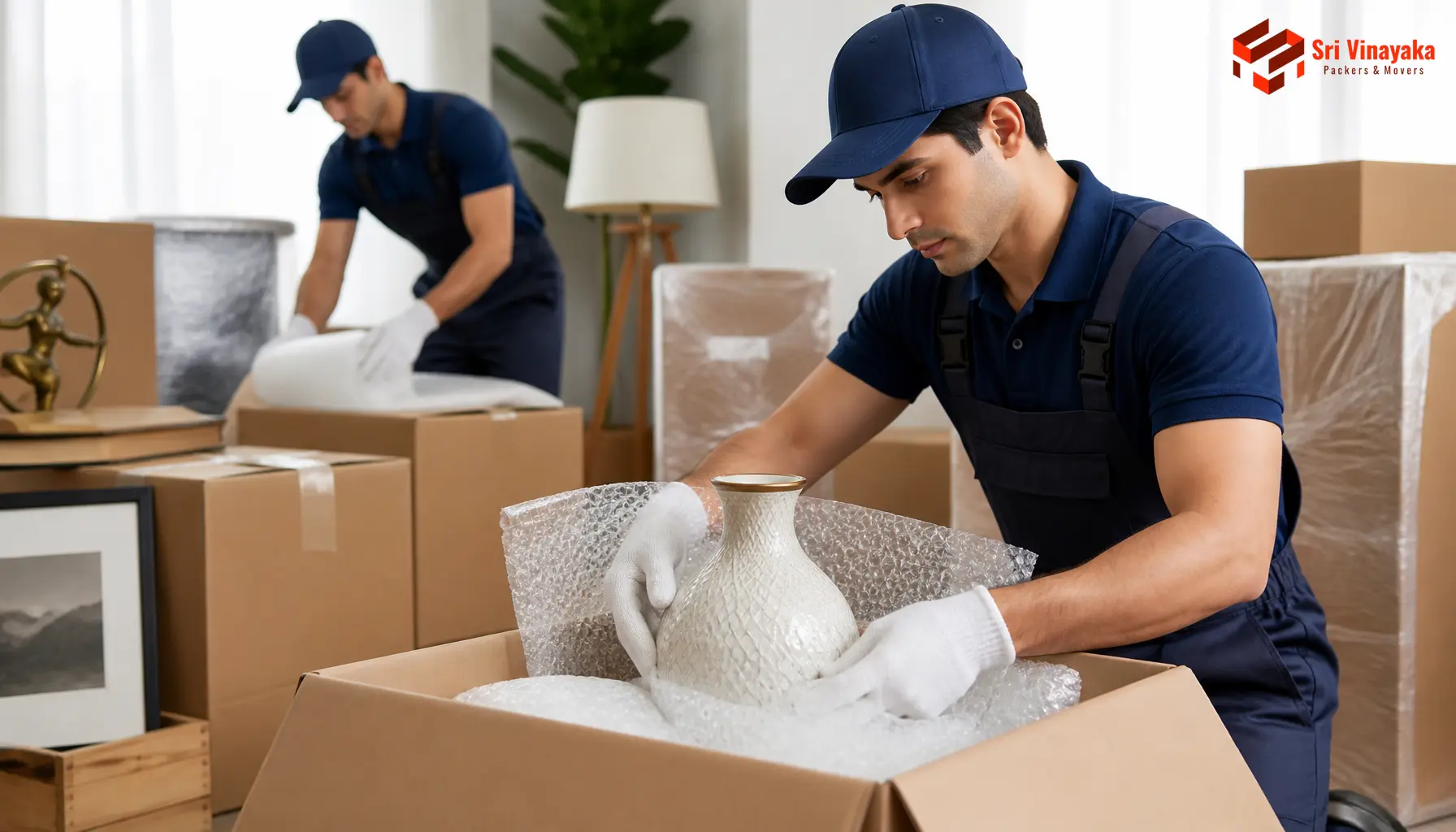
- Primary wrap with paper or bubble wrap — Every fragile object gets an individual first layer. Bubble wrap absorbs shock, while soft paper prevents surface scratches on glass and polished wood.
- Corners and edges protected with foam sheets — Mirrors, photo frames, and glass tabletops receive extra foam padding at their corners, which are the most vulnerable points during transit.
- Secondary protection in sturdy cardboard boxes — Items that have been wrapped are then put in cardboard packing boxes. Cartons which contain fragile materials are not filled to the top, and the rest of the space is filled with a combination of paper and thermocol for cushioning.
- Internal cushioning and separation — For crockery and glassware, each item is individually covered, and then they are stacked using a sheet of bubble wrap or crumpled paper between the items. This is to avoid knocking if one object shifts.
- “Fragile” labelling on all sides — The final step is the marking or labelling of boxes. A professional moving team stamps either “Fragile” or “Handle with Care” on the top as well as on all sides, so that everyone who handles the box at any stage is immediately aware. This is also part of a strong house shifting checklist.
How Are Fragile Items Loaded and Transported?
It is not only about packing; loading and transporting also play an important role. Professional movers place fragile items last in the van because this way they will be sitting on the other items that are quite heavy and solid and won’t be bearing any weight from above.
They surround fragile items with soft material to prevent them from getting shaken during transportation. Very sensitive things like big mirrors or flat-screen televisions are brought into the truck by carrying them on hand and putting in a position that is secure for them upright either in the back truck space reserved for upright things or in the front. Flat laying the mirror under other goods is strictly forbidden. The right loading and unloading service keeps such risks under control.
How Are Large and Heavy Items Managed?
The way heavy and big items are handled is very different from that of smaller things. If you think about it, a piece of furniture like, for instance, an expensive wardrobe will not look in its best shape after getting crushed by the weight of the other goods, right? And if that’s the worst, what about when it has to be moved through stairs, elevators, narrow doorways, etc.?
Professional movers use special moving gear such as dollies, hand trucks, ramps, and moving nylon straps. This makes physical work easier and at the same time minimizes possible harm for both the belongings and the house. You can read more about professional loading and unloading operations.
First of all, a furniture piece like a sofa, large wardrobe, or a modular kitchen, the crew disassembles. Legs, shelves, and other pieces are taken off, and screws and bolts are kept in marked hardware bags to facilitate faster installation at the destination. A fridge, a washing machine, and so on go on a van without any danger if properly moved using appliance trolleys and a set of straps, and they are kept vertical in the van to prevent any damage to their compressors and internal mechanisms. For safe furniture handling, see moving your furniture safely, and for transport support, explore moving and transportation.
What Items Do Packers and Movers Refuse to Pack?
Most people suppose that a packer-mover crew will pack anything you put before them, but the truth is, based on the experts in the industry, not everything is packed.
- Items that are legally prohibited — Weapons, explosives, and any other dangerous goods can only be transported on special conditions.
- Perishable food items — The team does not wrap fruits, veggies, and other perishables because of the risk that they could go bad and cause other goods to get spoilt as well.
- Cash, jewellery, and important documents — You will be solely responsible for such things which either cannot be valued or there is not a spare copy. You are advised to carry them yourselves. For high-value protection, consider relocation insurance.
- Plants and pets — These call for special transport services for pets that are different from what are normally expected during a move of a standard household.
Your relocator has to give you their list of prohibited items during the quote offering. Here the same point can also be used to inform them about any extraordinary article(s), so that the company will then have a chance to get the correct packing materials, right equipment, and insurance plan ready for you.
Important Tips for Shifting Special Items in India
City streets are very crowded, intercity distances are far longer, there are monsoonal rains to account for, and there’s a requirement to handle household goods having cultural/religious significance.
- For intercity moves, confirm whether the company uses road transport or train transport, and ask how weather-proofing is handled during the rainy season.
- For cultural valuables like brass idols, wooden swings, or elaborate pooja items, request separate packing and labelling. These items are often both fragile and emotionally valuable.
- For electronic items, keep the original packaging wherever possible. Original foam inserts provide the best protection for TVs, computers, and music systems. If original packaging is not available, anti-static bubble wrap is the next best option.
- For expensive items, always opt for transit insurance. While professional movers take every precaution, insurance gives you financial protection in the rare event of damage.
How to Coordinate with Your Moving Crew
Apart from the fact the job at hand is handed over to professionals and you only wait for the move, your involvement can actually help reduce any damage. Get yourself acquainted with the main points before packing, by touring the house with the head man.
At the time of packing, make sure the boxes carrying brittle contents have “Fragile – Handle With Care” on all sides. Check whether your team packed fragile objects last and put them on top without weighting. This kind of cooperation of yours is one more factor apart from the skills of an expert that can minimize chances of things that get mishandled.

A Quick Checklist for Shifting Special Items
Here is a quick-reference summary of everything discussed in this article:
- Declare fragile, heavy, and valuable items during the quotation itself.
- Use layered wrapping — paper, bubble wrap, foam, and sturdy boxes.
- Label fragile boxes on all sides with “Fragile — Handle with Care.”
- Ensure fragile items are loaded last and placed on top, never under weight.
- Choose professionals with trained staff and proper equipment for heavy items.
- Pack high-value items separately or carry them personally.
- Take transit insurance for expensive and irreplaceable belongings.
- Confirm the restricted items list before signing the contract.
If you need assistance in transporting your favorite items, a good example will be that of a professional relocation company. The advantage is, this is the only kind of company which will help you with planning, materials, and expert personnel.
If you are preparing a shift, Sri Vinayaka Packers & Movers is that reliable name in this area because they bring with them a skilled team, high-class packaging materials, and a well-optimized technique for transporting delicate items, from delicate pieces of glassware to large furniture. Thanks to precise planning and skilled execution, your family can rest assured that their delicate possessions will make it to their new home safely and without a scratch.
FAQs
Sure thing, professional packers and movers handle fragile items such as glassware, mirrors, lamps, and electronics only if they are properly wrapped with materials like bubble wrap, foam, and cardboard boxes. It is necessary that you tell the company about these things ahead of time so the crew can handle them with extra care.
Since handling heavy items needs specialized equipment, more manpower, and the use of more truck space, an extra charge is possible. It is the standard practice to assess most large items during the pre-move survey, so if you want to prevent having the bill unexpectedly increased on moving day, declare everything as early as possible.
For the packing, avoid things like cash, jewelry, documents that are of importance, food perishables, plants, pets, and legally forbidden items like explosives or combustibles. The moving company will give you a list of restricted items and you need to go through it before the packing operation commences.
Professional moving companies generally do take care of valuable things like antiques and paintings, and pianos, but they may require special wood packing and will separately assess their value. So, you need to bring up the topic of the handling of these items while getting the quote.
Handling of fragile items is done by wrapping them in paper and bubble wrap, putting them in a strong box, making sure all sides of the box bear the fragile label, and keeping them for the later part of the truck loading. Given the high likelihood of monsoons and the risk involved in long-distance road transport, various companies do provide additional security measures.